• My Paris
  • ParisbyWalking - Blog
  • ParisbyWalking - Guest Posts
  • About
  • Contact
  • Paris Tours
Menu

Paris by Walking

  • My Paris
  • ParisbyWalking - Blog
  • ParisbyWalking - Guest Posts
  • About
  • Contact
  • Paris Tours
×

Trâm.130 (photo: Amber)

Priscilla Trâm: Curiosity, Generosity, and Balance

Okan GORUR June 13, 2026

I’d like to start this article with a moment of pride. In fact, it has everything to do with the person at the heart of this story.

A proud moment:

— Dad, do you eat to live, or do you live to eat?

— To eat well, honey. What about you?

— Me too. (😍🤗💪🏼🎊🎉🎊)

A little later:

— Dad, I love cultural diversity.

— Why did you say that, sweetheart?

— Because if it didn’t exist, we wouldn’t be able to eat all these amazing foods in Paris.

(🥲 No, no, something just got in my eye. I’m not crying! 😁)

When we first moved to Paris, I chased French cuisine with real determination. I wanted to understand its traditions, learn its classic dishes, and figure out what makes a great bistro. Along the way, I dragged my wife—and occasionally my daughter—into this obsession.

Even today, because we speak Turkish at the table, waiters are often surprised when my daughter orders a steak tartare.

“You know it’s raw meat, right?” they sometimes ask.

That’s usually when my daughter replies:

“Yes, but is it served as aged beef, hand-cut with a knife, seasoned simply with salt and pepper?”

At that point, despite speaking a different language at the table, we’ve usually made it clear that we’re quite familiar with French cuisine.

Once we had worked our way through the great classics, we threw ourselves into the world of bistronomy through chefs like Yves Camdeborde, Bruno Doucet, Stéphane Jégo, Iñaki Aizpitarte, and David Rathgeber.

And then came the Japanese chefs who began leaving their mark on French cuisine—and we completely lost ourselves in that world.

(I’ve already written about who these chefs are on my blog. Don’t be lazy—go read it!!! 😁)

Now we’re witnessing another exciting chapter in the Paris food scene: talented young chefs in wine bars creating what feels like an ongoing festival of flavors.

Most of them work with small plates designed for sharing, somewhere between the meze culture I grew up with and Spanish tapas. They stay faithful to seasonal ingredients and constantly create new dishes. To keep reinventing yourself while maintaining a high level of quality seems incredibly difficult to me—but some chefs manage it.

One of them is the wonderful Priscilla Trâm.
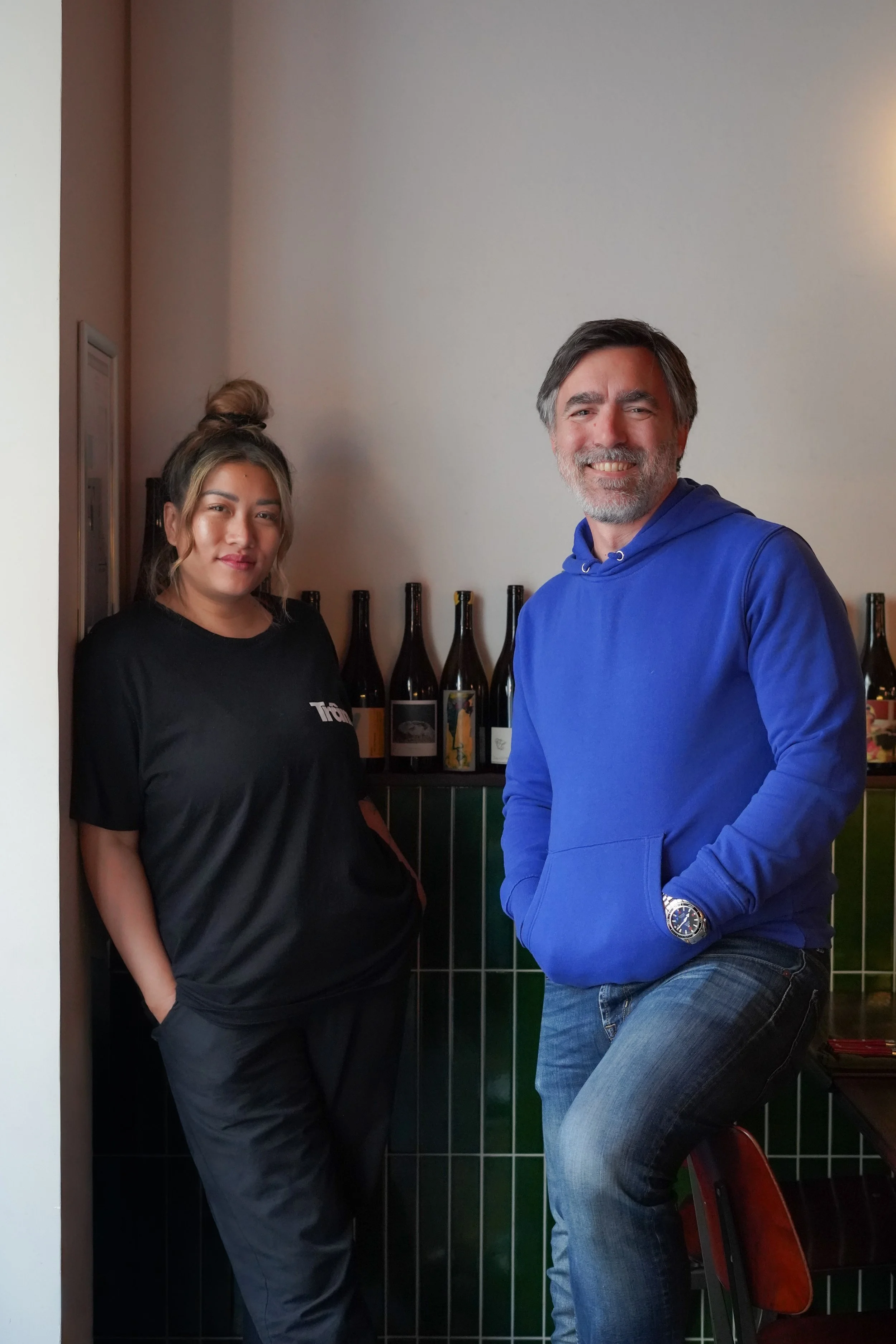
Photo: Amber

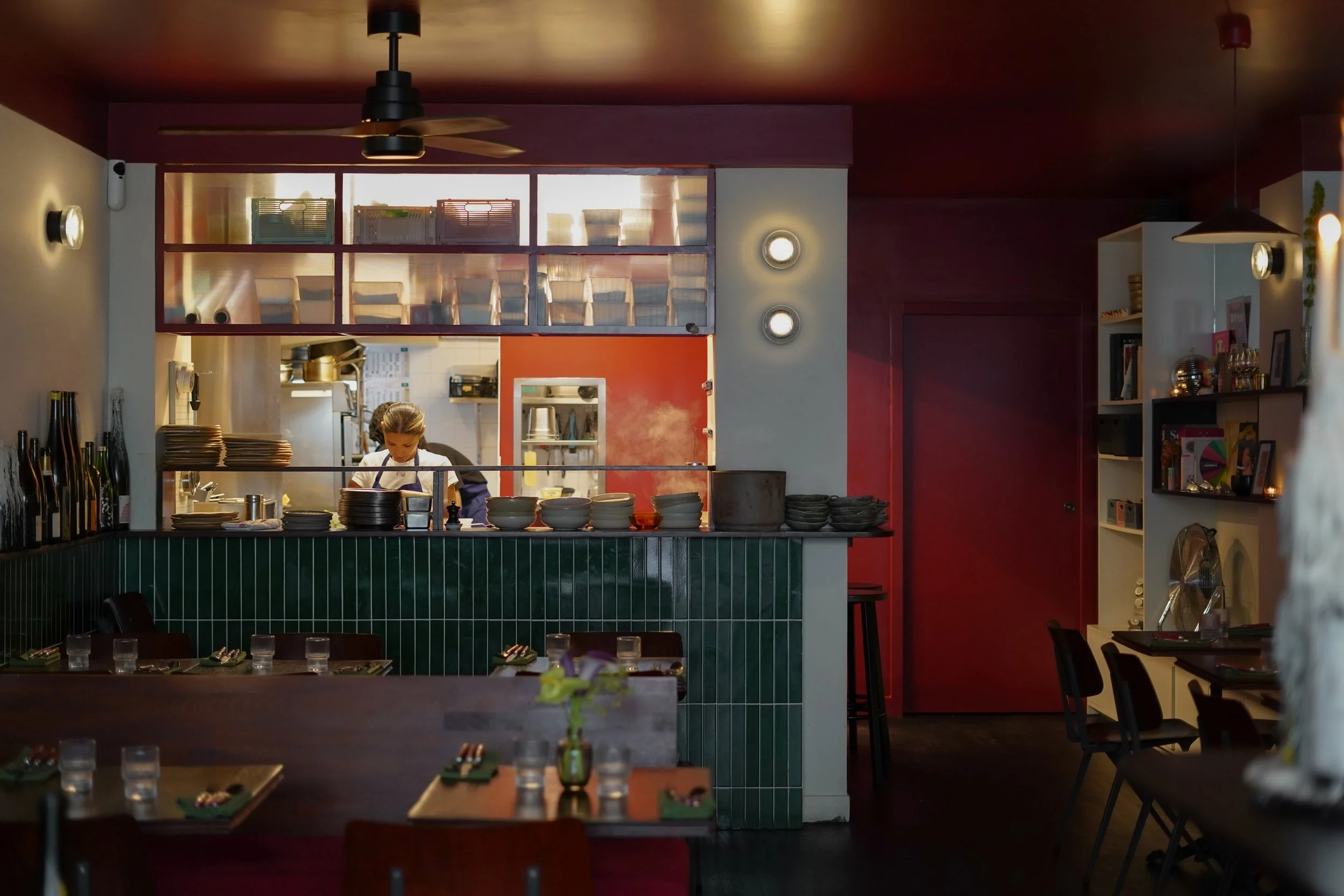
She entered our lives when she opened her restaurant in May 2024. By the beginning of 2025, Trâm 130 had already made its way onto my annual list of restaurants I absolutely had to visit.

Our first experience came on a beautiful summer evening when we decided to walk in without a reservation. Lucas Nivaggioni found us a table and guided us through the wine list. A bottle from Clos du Tue-Boeuf paired beautifully with the sea Bream & shrimp crudo—pickled rhubarb, trout roe, chili oil, and rice crisps.

Lucas shares service duties with Arthur Malet, who has also guided our wine choices on our more recent visits. That first night, a light skin-contact, high-acid white from Beck-Hartweg worked wonderfully with the razor clams, served with beer, garlic and lemongrass-infused butter, Thai basil, and lime.

On our most recent visit, I paired the beetroot dish with Le Blanc des Garennes from Rodolphe Gianesini & Laetitia Ourliac. Beetroot, for me, is a bit like the wines of Languedoc—a naturally funky ingredient. The aromatic character of the wine and the complexity of the dish came together beautifully.

So yes, you’re very lucky when it comes to wine at Trâm 130. Not one guide, but two.

I asked Priscilla how she met them. And, because I couldn’t resist, I also asked whether having two talented wine professionals on the team wasn’t just a little unfair when most people struggle to find even one great sommelier. 😁
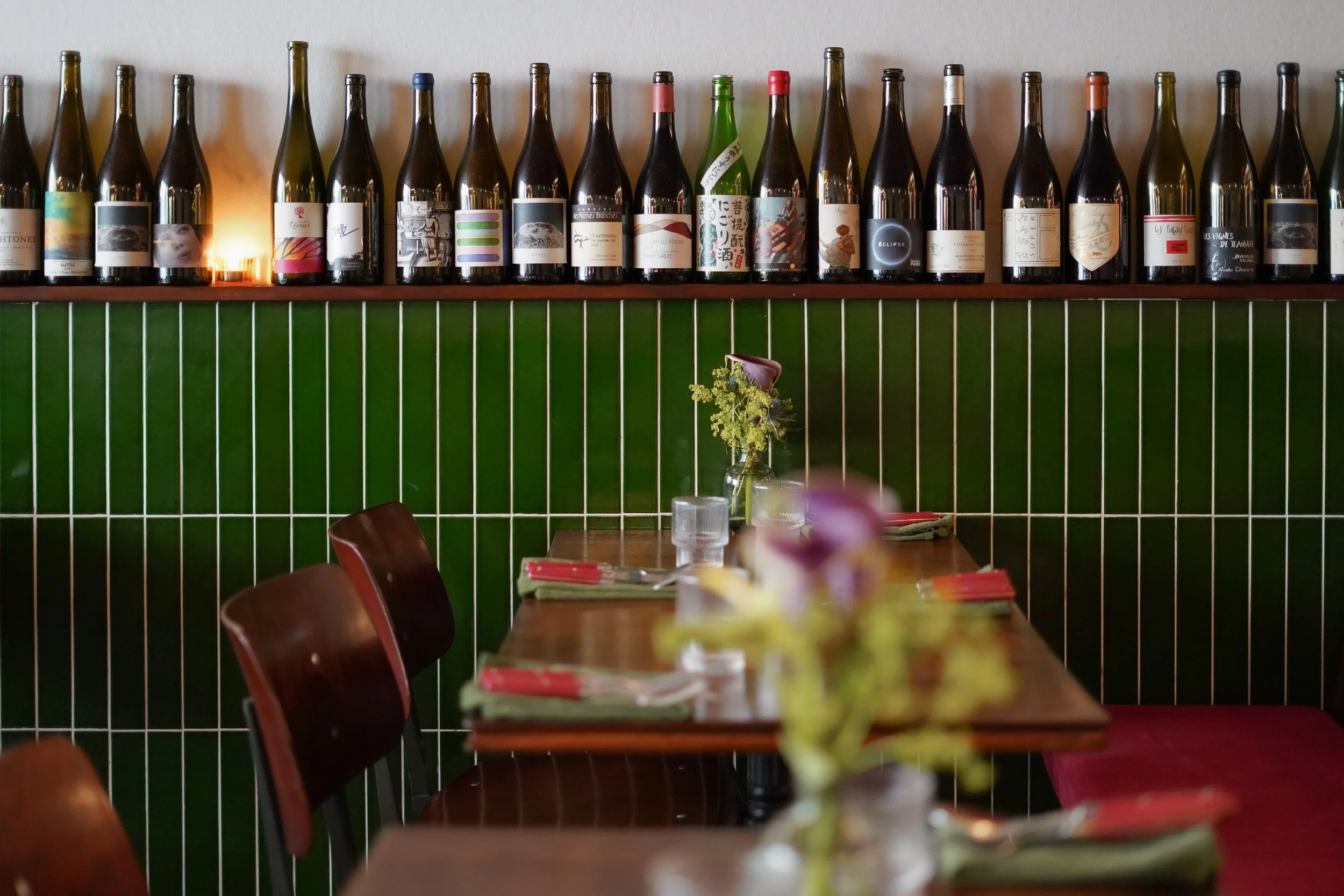
Lucas and Arthur’s wine selection (photo: Amber)

I met Lucas through social media. At the time, I was looking for someone to help out occasionally. Very quickly, we developed a real connection, both personally and professionally. He immediately understood the spirit of the restaurant. Arthur already knew Lucas, and joining the team happened quite naturally. They each have their own personality and their own approach to wine and service, and that’s precisely why they work so well together. Over time, Lucas also took on more operational responsibilities and eventually became my Director of Operations, overseeing the administrative side and the day-to-day running of the restaurant.

And yes, objectively speaking, having two people like that is a little unfair 😁. But then again, I’m worth it, aren’t I?

One thing I particularly appreciate about Priscilla is that once the rush in the dining room eases, she takes the time to speak directly with her guests. That kind of genuine interaction is invaluable. She gets to witness people’s enjoyment firsthand, and I suspect that’s one of the main reasons she loves what she does so much. I benefited from that openness myself. After a conversation at the restaurant, I managed to convince her to do this interview. And I have to admit, I had a great time reading her answers. As you go through them, I think you’ll understand why her food is so good. The same curiosity, generosity, thoughtfulness, and energy that come through on the plate are all there in her words as well.

Was food one of the occasions that brought your family together when you were growing up? Who did the cooking at home? What’s your earliest food memory?

Yes, meals were very important. Growing up in a family of Vietnamese origin, there was always rice on the table, along with a broth, vegetables, meat or fish. My mother was the one who cooked, as is often the case in many Asian families. She managed three dry-cleaning shops, picked us up from school, helped us with our homework, and cooked at the same time. She had very little time, yet she always made sure we were well fed.

Food was important when I was a child, and restaurants were already part of my life long before I ever imagined opening one myself.

When my father emigrated from Vietnam, he started working in Parisian restaurants at a very young age. He worked his way through every position in brasseries such as the Drugstore before eventually becoming a maître d’hôtel.

He often took me out for late dinners, even when I was very young. I would spend hours sitting on restaurant banquettes, watching the service unfold, observing plates leaving the kitchen, listening to the sound of glasses, and soaking up the atmosphere at the end of the evening.

Those banquettes are my childhood.

That’s where I fell in love with restaurants, even before I fell in love with cooking itself.

And some of those places still exist today, such as Le Pied de Cochon or Malibu on Rue Tiquetonne.

I read that you started your career as a lawyer. What was your area of expertise? And what made you fall out of love with it? A brutal divorce, a messy bankruptcy, a murder case? 😬

Thankfully, not a murder case. 😂

I was a lawyer specializing in anti-corruption and international investigations, and I was admitted to the New York Bar. I practiced for fifteen years, particularly in Hong Kong.

About six years ago, I started cooking seriously—almost in secret at first. During the day, I was working as a lawyer at a law firm; in the evenings, I was cooking for private dinners, pop-ups, and collaborations. I was genuinely living a double life.

In Hong Kong, I discovered a remarkably free and creative food scene: intimate restaurants, sometimes hidden inside apartments, independent venues operating far outside the traditional restaurant model. It had a profound impact on me and completely changed the way I viewed hospitality.

Little by little, cooking began to take up more and more space in my life. It was no longer just a side passion. It demanded the same level of discipline and rigor as my legal career, but more importantly, it made me deeply happy.

Eventually, that double life became impossible to sustain. I felt as though I was never fully present in either world, as if I was letting both of them down.

At some point, I had to choose. I chose the kitchen.

I also read that you worked at Yard in Paris’s 20th arrondissement, at the arty boutique hotel La Pandilla in Ibiza, in Madrid’s Plaza del Biombo, and at candlelit dinners at RecCreate Gallery in Brooklyn. After all those experiences, why did you choose to stay in Paris? Do you see Paris as your long-term home, or could you imagine moving elsewhere in the future?

Paris is my natural center of gravity. I was born here, my family is here, and so are my roots. Paris offers something quite rare: you can be deeply respectful of tradition while remaining endlessly curious. There is a real level of expectation when it comes to ingredients, technique, and flavor, but there is also a constant energy of renewal and reinvention.

I love the idea of building something over time. Opening a restaurant isn’t just about cooking food; it’s about creating a place, building loyalty, and creating memories.

Today, Trâm 130 is here, and soon there will be Trâmette: a deli-style counter during the day, transforming into a wine bar and restaurant in the evening. It’s another way of extending and expressing my cooking.

I was fortunate that word of mouth around my food grew quickly. I’ve been invited to cook in different places, to take part in residencies, and to host dinners around the world. But Paris remains the center of gravity.

That said, I feel a strong pull toward Vietnam, especially Ho Chi Minh City, where my father and brother live. There are incredible things happening there: an energetic younger generation, a vibrant creative scene, and a food culture that is constantly evolving. I’d love to become part of that story in my own way.

And over the longer term, Brittany keeps calling to me as well. Its raw beauty, its pace of life, its relationship with both the sea and its produce… it’s a place that speaks to me on a very deep level.
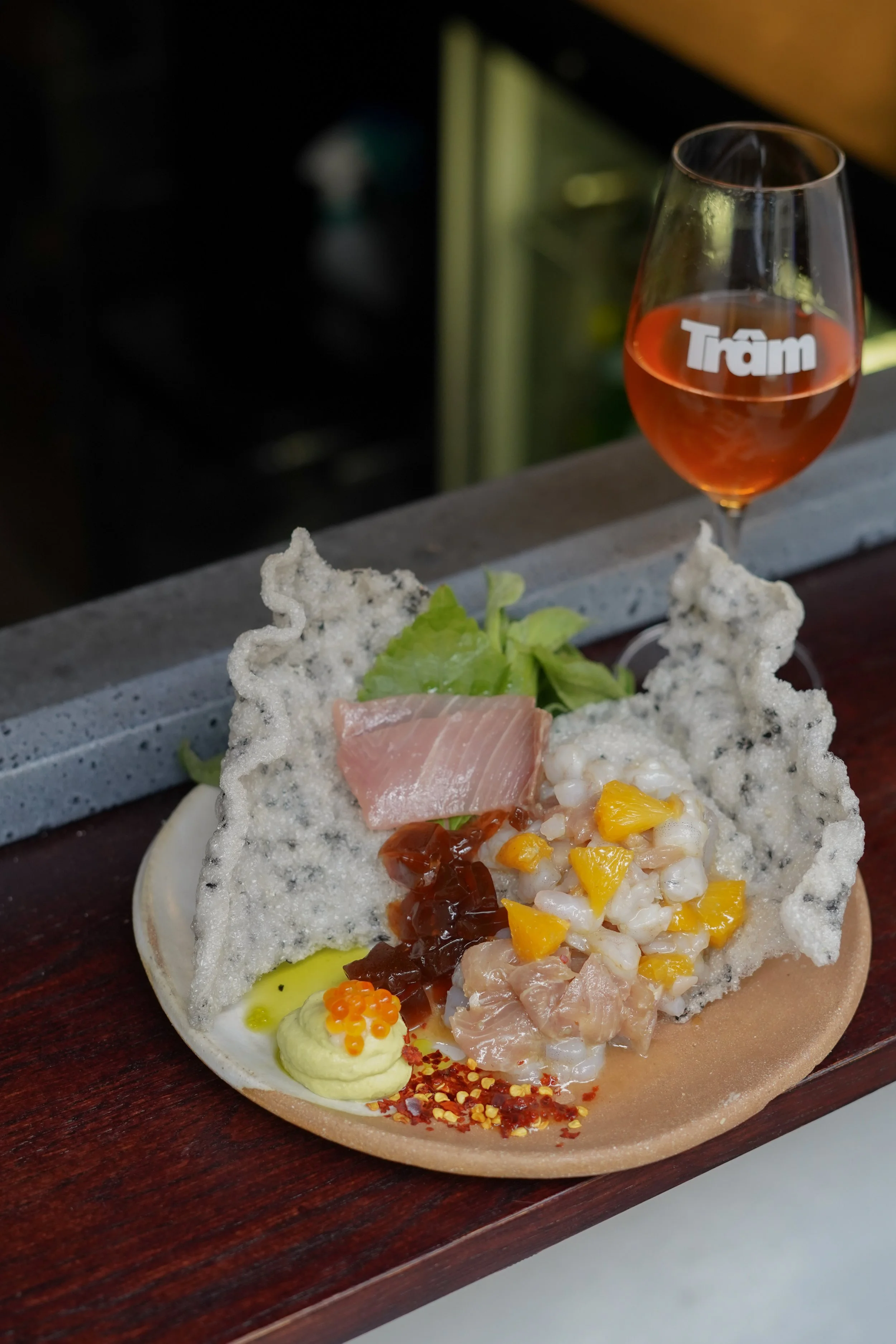
a tribute to sea (photo Amber)

We can clearly see and taste Asian influences in your cooking. Could you tell us a bit more about that? When you combine those influences with French ingredients, what do you pay the most attention to? And when it comes to chili heat and spice, how do you decide where to draw the line—based on your own palate, or by testing dishes on the French members of your team? 😁


My cooking is built on a very French foundation: butter, sauces, cooking techniques, and a deep respect for ingredients. But my flavor instincts come largely from Southeast Asia, and particularly from Southern Vietnam—the balance between richness, acidity, saltiness, sweetness, heat, and umami.

I’m not particularly fond of the word fusion, because it often reduces something complex to a simple juxtaposition of ingredients. For me, it’s not about placing an Asian ingredient on a French plate; it’s about creating an overall sense of balance.

When I work with a French product, I’m always careful not to overpower it. A condiment should support an ingredient, not dominate it. Take chili, for example: it shouldn’t be there to prove a point or to shock people. It should be there to add dimension and depth.

And yes, I do a lot of tasting with my team—which is probably a good thing, because my own tolerance for spice has become a fairly unreliable benchmark. 😁

Are there any Asian ingredients that don’t exist in France but that you would love to use in your cooking?

Yes, many. Especially very specific herbs, different varieties of basil, aromatic leaves, fruits used for acidity, or very local fermented products.

Even when you can find them in France, they don’t always have the same intensity or freshness.

An herb picked in Vietnam at 35 degrees in the morning simply doesn’t taste the same as one that has traveled for several days.

It’s often less about rarity than about the vitality of the product itself.
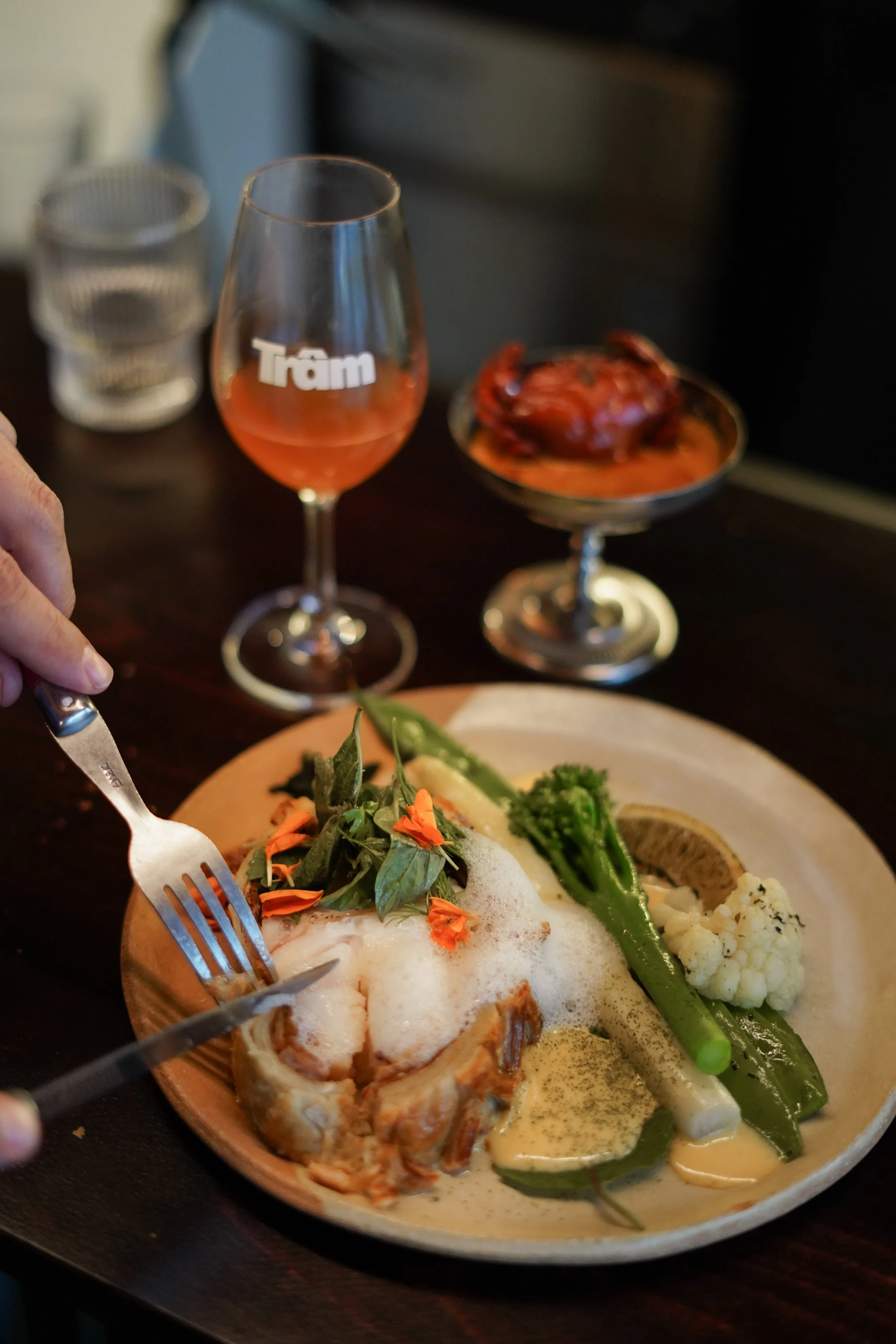
monkfish wellington (photo: Amber)

What do you use to keep learning and evolving? The internet, magazines, books, documentaries…?

I draw inspiration from a bit of everything, but mostly from meals, conversations, and everyday observations.

The books and television programs of Anthony Bourdain had a profound influence on the way I see this profession. I was deeply touched by his vision of cooking and of the people behind it—something both tender and honest at the same time.

For the foundations of classical French cuisine, La Cuillère d’Argent remains an important reference, while Auguste Escoffier is essential for understanding the fundamentals of traditional cooking.

Through books, I’ve also learned a great deal about culinary history: how food has always been connected to power, trade, and social change. For example, Louis XIV had what was essentially an army of cooks around him, and after the French Revolution, many of those chefs went on to open some of the first restaurants.

It’s also fascinating to see how culinary traditions evolved through exchanges between civilizations. Ancient Roman cuisine, for instance, used powerful seasonings such as garum, which in some ways resemble the role that salt and fermentation play in certain Asian and Thai cuisines today.

Going to markets is equally indispensable for me. I am just as curious walking through a foreign hypermarket as I am visiting a local farmers’ market. Watching what people buy and what they eat is often where you begin to truly understand a culture.

Whenever I have time, I also love going to restaurants and discovering the work of other chefs.

There’s also Modernist Cuisine, which was a birthday gift from my younger brother. It’s an extraordinary work that covers everything from technique and product knowledge to cooking methods and textures.

And above all, there’s repetition: making a dish again, understanding why it wasn’t quite right, adjusting it, and starting over.

That’s often where the real learning happens.

What’s your take on the Paris food scene today? What do you think the next two or three years have in store for us?

The Paris food scene is incredibly competitive and in constant motion. There are new openings everywhere, fresh ideas, changing concepts, and a new generation of chefs emerging all the time.

Many of those young chefs—myself included—have come to cooking through career changes rather than traditional culinary paths. That often brings a different perspective and a different way of thinking about food.

At the same time, we’re seeing a real return to brasseries, bouillons, and a style of cooking that is more straightforward and accessible. Alongside that, wine bars with serious chef-driven kitchens continue to thrive. The lines between restaurants, bistros, caves à manger, and bistronomy are becoming increasingly blurred—and I find that incredibly exciting.

That said, there’s also a very real economic reality. Ingredient costs continue to rise, operating expenses are increasing, and consumers are either spending less or simply spending differently. As a result, restaurants need to be far more agile, precise, and consistent in what they offer.

There’s also another Parisian reality: many people are leaving the city. That inevitably changes the way you think about a restaurant, its identity, and the audience you’re trying to serve.

As for me, I also have some long-term ideas involving Brittany for more personal reasons—but perhaps that will be the subject of another interview a few years from now. 😉


Are there any Paris-based chefs who inspire you? And perhaps a few names from elsewhere in the world as well?


There are many Parisian chefs who inspire me—sometimes through a meal, sometimes through a personal encounter.

Thanks to the pop-ups I’ve done over the years, I’ve had the chance to meet chefs who taught me a tremendous amount, even during very brief collaborations. From each of them, I took away something valuable: wisdom, discipline, confidence, or simply the desire to push myself further.

Alcidia Vulbeau is one of them. We worked together on a pop-up, and she runs a wonderfully poetic, market-driven, seasonal kitchen at the Saint-Ouen flea market. She works out of an incredibly small kitchen and taught me a great deal about resourcefulness, efficiency, and the importance of doing things well, even with limited means.

Then there’s Antoine Griton, whom I met at Yard and who is now at L’Arlequin. When we worked together, he was only twenty years old, yet he already had the precision and rigor of a pastry chef. He’s one of those people who leaves a lasting impression.

I’ve never actually worked with Tomy Gousset, but before opening the restaurant he generously took the time to meet with me and help me refine my business plan. That kind of support means a great deal, especially when it comes from a chef with such an accomplished career.

There are also chefs who have inspired me simply through their cooking. One example is Giuliano Sperandio at Taillevent. At the time, he was one of the pioneers of bistronomy. His career, his humility, and that particular dinner remain among my most memorable culinary experiences in recent years.

Internationally, I have enormous admiration for the chef of Sushi Ikkyu, a tiny eight-seat omakase counter in Setagaya, Tokyo.

Throughout his entire career, he has hardly taken a single day off. There is something deeply admirable about that level of devotion to one’s craft.

He once told me about his passion for vintage cars and the 24 Hours of Le Mans. What stayed with me was that he had booked trips to France several times, only to cancel at the last minute every single time because he felt he should stay and work instead.

For someone running an eight-seat sushi counter, that kind of discipline, commitment, and loyalty to his chosen path says a great deal about the way he sees his profession.


What’s your guilty pleasure food? McDonald’s, sausages, something else? 😁


Instant ramen.

When I’m tired and craving some comfort food, I make a bowl of instant noodles and add an egg yolk, fried garlic, sometimes a few vegetables, and plenty of chili. It very easily satisfies any cravings I might have for fries or burgers.

Other than that, I love Popeyes chicken wings and processed cheese.

But are you really going to publish that? Hahaha.”


(Of course I published it! Dear Priscilla, Paris by Walking has always been on the side of direct and honest communication. Hahaha.)


What are your favorite restaurants in Paris?


That really depends on my mood.

For a family Sunday lunch, I’d say Sinorama. I’ve been going there since childhood—for its wonderfully flavorful Cantonese cuisine and for everything that place represents to me.

For a tasting menu, I love Paulownia. There’s a great deal of finesse in the cooking, everything feels perfectly balanced, and every meal is a journey made up of countless small discoveries.

When I’m in the mood for beautiful Japanese fish without too much formality, I go to Takara, the oldest Japanese restaurant in Paris.

And for a late team dinner after service, Le Pied de Cochon remains a classic and reliable choice.
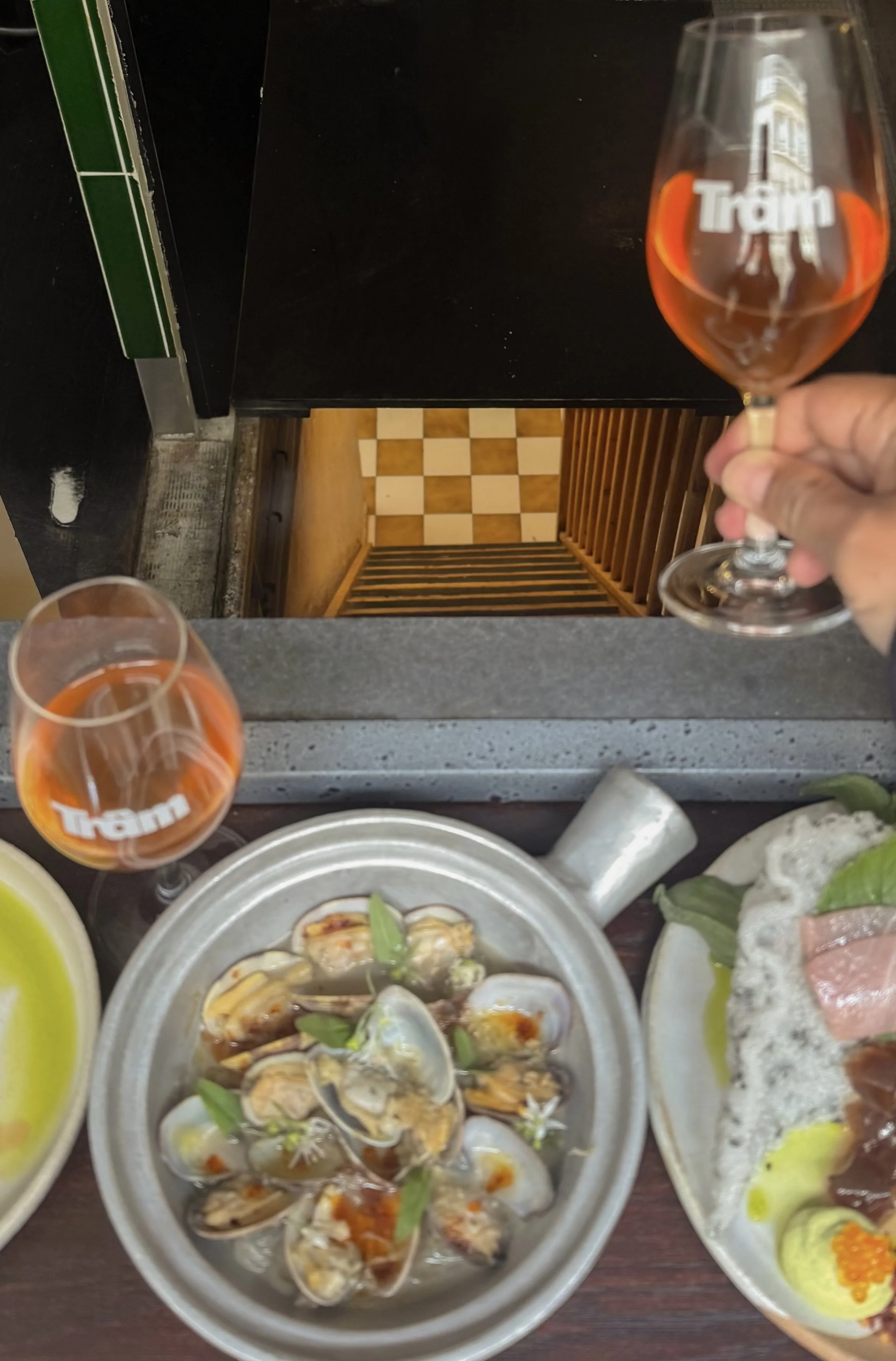
brittany clams with savagnin (photo: Amber)

In Gastronomy, Food Tags parisbywalking, pbw, pbw11th, pbw11eme, pbw11rest, parisianlife, parisfood, paris, paris_maville, parismaville, parisfoodguide, iciparis, cestparis, localeats, localguide, walkingtours
Comment

photo by Asli

Coffee, me & 3micro cafés

Okan GORUR December 19, 2024

The topic of this article is coffee, so let me start by talking about my relationship with it. I’ll get straight to the point—I had no relationship with coffee before moving to Paris. 😅 Surprising, isn’t it? A grown Turkish adult resisting the reality of Turkish coffee! What can I say? I didn’t like it, couldn’t like it. However, shortly before moving to Paris, when opportunities arose to meet other parents after dropping off or picking up my daughter from school, the stress of the inevitable question, ‘Shall we grab a coffee?’ pushed me to take an interest in coffee. With a little research, I realized that Paris wasn’t much different from me when it came to coffee. Parisians drink bad coffee at bistros. I’m talking about 2017. Back then, there were no more than ten third-wave coffee shops in Paris. And yet, the French played a significant role in the global spread of coffee. They smuggled coffee seeds from Madagascar and planted them in their colonies in the Caribbean islands, including Haiti, ensuring they didn’t miss out on the coffee trade. In fact, the first coffee shop in Paris, Café Procope, opened in 1672. And yes, it’s still open today—though it’s no longer a café, but a restaurant.


The third-wave coffee shops I discovered in 2017 all sourced their own beans—they were both roasters and cafés. As I slowly tried them all, I began to explore the vast world of coffee. During this time, I also read three books: Coffee Isn’t Rocket Science, The New Rules of Coffee, and The Curious Barista’s Guide to Coffee. ☕️ Meanwhile, I witnessed Paris’s coffee scene evolve. According to an article I read, specialty coffee sales in France have risen by 14% since 2019, reflecting growing demand for artisanal and ethically sourced coffee. The overall coffee market is expected to grow by about 1.14% annually between 2023 and 2025. Another study suggests that the French coffee market will see a compound annual growth rate of 5.7% from 2024 to 2030. I couldn’t find any official figures on the number of coffee shops opening and closing in Paris. If you ask me, it feels like a new one opens almost every day. 😂 The meaning of the word ‘café’ has also become quite muddled. There are the classic spots selling good coffee and a few pastries, but then there are also places serving tapas and wine. The ‘café’ scene in Paris has grown more diverse and layered. Of course, being an old-school person who enjoys simplicity, I’ve dedicated this article to three micro-coffee shops. I must admit, the idea of running a place like this is always lingering at the back of my mind. While I keep dreaming, let me introduce you to three young men who’ve turned their dreams into reality with their micro coffee shops.


photo by Asli

The first café is the oldest among the three. I say ‘oldest,’ but they’re all very new. Mini Café is Loïc’s place, and its location is one of my favorites. It’s been open since January 2023. Loïc spent a few years in Asia, where he had the chance to visit coffee plantations in Thailand, Vietnam, and Laos. Honestly, I can’t think of a better motivation to come back to Paris and open a café. He enjoys all coffee drinks, as long as they’re well-executed. Over time, he’s worked with various roasters, but currently, he serves coffee sourced from Frukt, a Finnish roaster. Loïc’s thoughts on the Paris coffee scene align closely with mine: good coffee is becoming a part of French life, creating opportunities for new investments, concepts, atmospheres, and recipes. Mini Café is located on the Île Saint-Louis, just next to Île de la Cité, the island at the heart of Paris where the city was founded. After visiting Notre-Dame, you can stop by to try their coffee. Don’t worry—the usual tourist crowds aren’t an issue here. Especially on sunny days, it’s a joy to hang out around Loïc’s café.


photo by Asli

photo by Asli

Since you’ve visited Notre-Dame and made your way to Mini Café, you must have an interest in history. In that case, head over to Bastille, one of the most important squares in Paris and French history. From there, it’s just a 13-minute walk to Abner’s place, Saint Barista. Isn’t that a fantastic name? He opened the shop in June. Compared to the other café owners, he seems the luckiest to me because he was practically born into the coffee business. He said; “My grandfather had a coffee finca in Guatemala, my home country.” Although he didn’t take an interest in coffee until he was 17, he grew up observing how his family managed the business. When he applied for a job at 17, he had to complete coffee training, and that’s when he finally embraced the family trade. Drawing on all these experiences, Abner loves connecting with his customers, sharing both his coffee and his craft, and getting to know the people who walk through his doors. He doesn’t have a preference for coffee from a specific country; instead, like me, he enjoys tasting and drinking coffees that are made with care and passion. Lately, he’s been experimenting with Aeropress brewing and is increasingly pleased with the results. He prefers to work with a different roaster every 2-3 months. While I was preparing this article, he was collaborating with DAK, a Dutch roaster with Canadian roots. He also offers flexibility to his customers by providing two espresso options.Abner hopes to see a friendly community develop in the Paris coffee scene, where business owners and customers take care of each other. From what I’ve observed over my seven years in Paris, if business owners or chefs do their job well, Parisians always support them and show their loyalty. I believe Saint Barista has the potential to thrive for years to come.

photo by Asli

photo by Asli

Now, let’s move on to our last micro-coffee shop, the newest of the trio. By the way, I assume you’re still continuing your tour of historic squares and have now arrived at Place de la République. 😁 (For some reason?!? 😁) When you’re tired, I have another great coffee recommendation just six minutes away on foot: Press Café. This is the newest spot, having opened in July 2024. I think it’s the perfect time—August in Paris is quiet, making it easier to settle into a new shop and routine.David got hooked on coffee six years ago and has been planning to open his shop for three. He found inspiration in the small coffee shops of Amsterdam and Japan. Colombian coffee is one of his favorites, standing out just a little more than the rest. At Press Café, David works with two excellent roasters. He uses espresso beans from Honduras roasted by Lomi, where he’s found a nice balance. For gentler brewing methods, he chose fruitier beans from Colombia and Brazil roasted by Fève. Another thing I love about Press Café is the music selection—David has great taste. While the shop isn’t big enough to sit and relax inside, you can enjoy the music and coffee outside on a nice day. David also sees the Paris coffee scene as inspiring and full of potential. He believes many neighborhoods still need good coffee shops and quality coffee.

One common feature of these three places is that, as long as there isn’t a line behind you, you can enjoy a delightful conversation with Abner, David, or Loïc. The chats often start with coffee but naturally flow into life. This even made me wonder—could baristas take the place of bartenders we see in movies, the ones who love to chat and listen to people’s troubles? 😁

In Food, Gastronomy, Paris, Travel, Coffee Tags pbw, parisbywalking, paris, parisianlife, parismaville, paris_maville, parisfood, parisfoodguide, parisgram, paris_gram, cestparis, iciparis, seemyparis, doitinparis, thisisparis, igersparis, urbansiderparis, walkingtours, pbw4eme, pbw4th, pbw11th, pbw11eme, pbw3rd, pbw3eme
Comment

photo: Amber

My Routine

Okan GORUR March 17, 2024

It's clear that I haven't been able to establish a rhythm for my writing habit. We can debate whether I'm putting in enough effort, but after a certain age, when you change countries, many old and new habits take different durations to settle into a routine than you might expect. Especially, like me, if you come to a country with your spouse’s assignment without finding a job, and if you don't know the language at all, then your situation becomes even more challenging. It's essential to find activities that will become part of your new life and keep you disciplined. It could be something as simple as taking your child to and from school. This is very important to me; chatting with my daughter while going to and from school, witnessing her growth, is one of the most enjoyable ways. As she grows older, our walking time has decreased, but that's okay; every age has its pleasures. Next year, she'll be in sixth grade and will prefer going to school without her father. This means that I'll need to develop a new habit for mornings next year. It might be exaggerated, but wouldn't it be great if I started doing sports, right?!?!

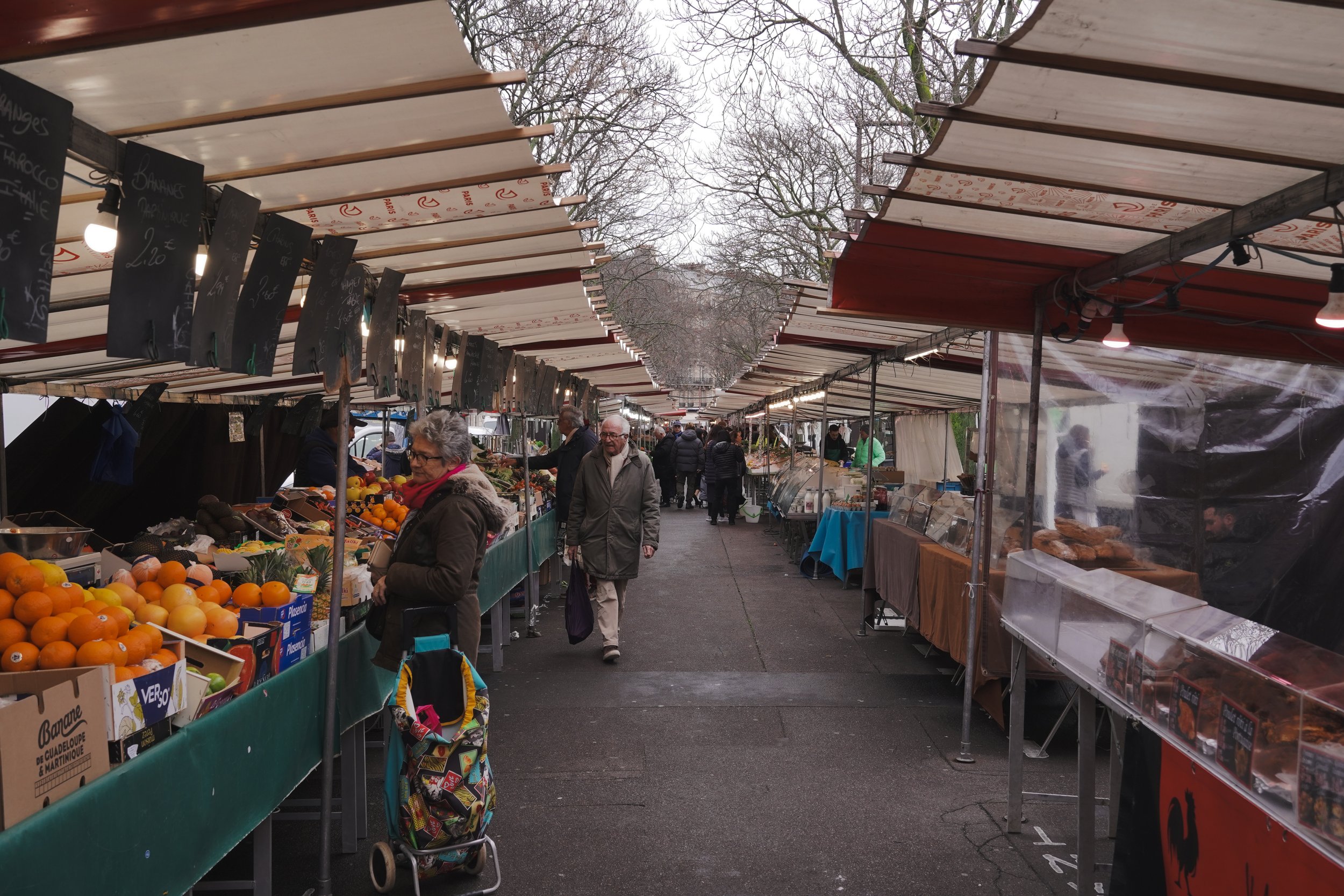
My second routine in Paris became "going to the market." Except for school holidays, you can see me every Wednesday at Avenue President Wilson market. Located between Iéna Square and Alma Square on Avenue President Wilson, the market is held on Wednesdays and Saturdays, opening early in the morning and closing at 2:30 PM. Frankly, the variety of products on Saturdays is much better than Wednesdays; if you have the chance, I recommend going on Saturdays. I'm not saying this because I go there regularly, but among the markets I've seen while walking the streets of Paris, this is one of the best. One of the characteristics that make up the city's spirit is each neighborhood's own shopping streets and local markets. The Parisians' commitment to this culture is one of the most important factors for me to love this city. Watching an elderly Parisian with a grumpy look and a seller who you wouldn't believe enjoys his job sharing recipes with each other in a butcher's shop is a wonderful moment for me. So when the "home delivery in 15 minutes" initiative came to Paris, I told my friends it wouldn't work, and I was right. Especially in food shopping, reducing or cutting off the contact between seller and customer, like trying to change the culture of Parisians, is also not possible.

In the 20 arrondissements of Paris, 72 markets are set up. You can check where and on which days they are set up on the city's official website. To rent a space at the market, you need to obtain permission from the local municipalities. The process typically begins with the applicant applying to the relevant administrative authority, which evaluates the suitability of the vendor and the products they plan to sell. Among the key requirements are providing fresh and locally sourced products, offering a variety of items, keeping the stall clean and organized, and clearly displaying prices. Additionally, local authorities expect vendors to create a friendly and professional atmosphere by communicating with customers in a warm manner. Generally, the places where the products come from and the production methods (such as organic-bio) are indicated on the labels.

Seeing dried grapes, dried apricots, dried figs, and quinces coming from Turkey through the labels makes me very happy, indeed. Here, at one of these stalls, there's Azdine. I can say that I made my first attempts at speaking French with him at the market. He's so polite that he has been putting up with me for years. In addition to dried fruits from Turkey, his stall also offers many varieties of nuts, mezes, and the types of olives that I buy most frequently. In France, olive and olive oil consumption is significantly lower compared to Italy, Spain, and Greece. So finding olives that suit my taste is not easy either. Thanks to Azdine, he allows me to taste 2-3 varieties before deciding which olives to buy. He has been doing this job for 30 years. Azdine's attitude reminds me of the vendors in Yeşilköy market from my childhood. Always cheerful, always talkative, and always loud. The flower stall across from him is his favorite because the scents wafting from there especially in spring make him very happy. He says that chatting with customers is the most enjoyable part of his job, and indeed, in the small question-answer interviews I conducted, all the vendors mentioned that chatting with customers is their favorite part of their jobs.

Azdine was the last to reply to my e-mail so he deserves my “sympathy” (photo: Amber)

One of the most enjoyable conversations you can have is with Carine, right next to the Azdine’s stall. She has been at the helm of her own company, BaraPatates, since 2007. In my opinion, she's the queen of the market. The quality of the products on her stall is always top-notch, and she has a variety of mushrooms that you won't see at any other stall. Because she also loves cooking at home, she pays great attention to ensuring that the products on her stall are as high-quality as those she brings home. She doesn't put any product on the stall that she doesn't like. This attention to detail and pursuit of good ingredients is a tradition passed down in her family because Carine's family has both a catering company and butchers. Now she's passing this tradition on to her children. One of my favorite moments at the market is when Carine shares recipes with a very chic Parisian woman. I know, this might get me into trouble in the future because when I improve my French to that point, Carine won't want to see me around her stall anymore because I'll be trying to ask for a new recipe every time. One of the things market vendors dislike doing the most is carrying crates, and Carine thinks the same way, rightfully so, she even had to undergo shoulder surgery because of it.

Kneel before the queen of mushrooms ! (Photo: Amber)

Another market vendor who doesn't particularly enjoy the setup stage is Herminia 'Mimi' Pereira at the Saint Vrain cheese stall opposite Bar a Patates. Setting up Mimi's stall is more challenging. The care needed to transport cheese and other dairy products is different from that needed for potatoes and onions, of course, so preparing the stall requires a serious level of concentration and patience. Once that's taken care of, the job becomes easier. Mimi's favorite moments in her job are when customers are told to her how satisfied with the products they purchase. I recommend visiting the Saint Vrain stall especially on Saturday mornings; the variety of cheeses there can be overwhelming. Lastly, let me tell you why Mimi and I get along so well: Both Mimi and I love comté cheese the most among all the cheeses. Actually, this isn't all that rare because it's really hard not to love comté. It's made from unpasteurized cow's milk in the France-Comté region near the Swiss border in eastern France. It's one of the most produced cheeses in France, and its production process undergoes strict controls, including calculating how many cows can be on how many square meters of land. These standards are referred to as French Appellation d'origine Contrôlée (AOC). By the way, Comté pairs beautifully with the white wines of the Arbois appellation in the Jura region. You should try it when you come to Paris.

note for the smart-a.. ; we are aware that the cheese is not comté but we like this photo the most.

(photo: Amber)

Talking about white wine immediately brings fish to mind. I confess, I never used to buy fish from the market in Turkey, so I didn't buy it here in the early days either. Then I put an end to this nonsense and started buying it. After making a few changes to the stalls over the years, I've been benefiting from Jean Pierre's 40 years of experience for the last 2 years, and I started buying fresh fish and seafood from his stall. His advice on how to cook them has improved the quality of our fish dinners at home. Jean's advice is very accurate because he cooks at home. Of course, Jean's least favorite thing about the market is the cold weather. The reason he complains more than other vendors is actually quite clear: in winter, having to clean fish with hands exposed to water! He's not entirely wrong, don't you think?

gratter & vider ; the first 2 French words i learned for fish shopping. (photo: Amber)

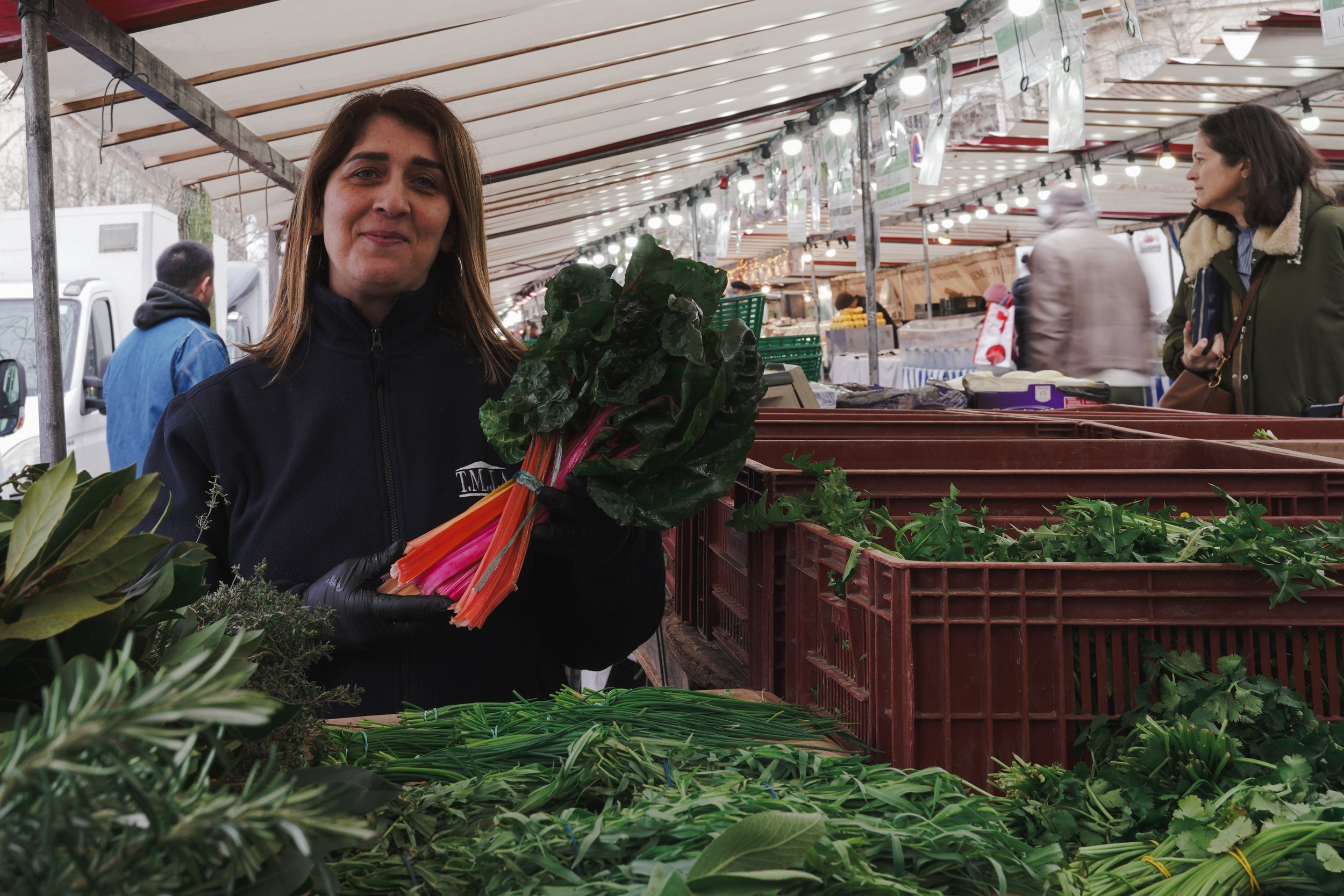
When Jean wants to buy something from the market, of course, he prefers vendors who bring organic products from their own gardens. One of these stalls is ValdemarBerreira's. They grow their products on lands 40 minutes outside Paris. You should see the variety of herbs in spring; they are incredibly colorful and fragrant, and towards the end of summer, they have various types of tomatoes. Valdemar took over this business from Joël Thiébault, who was famous as a supplier for starred restaurants, in 2016. His wife, Zilda, also joined the team. Like her colleagues, Zilda doesn't like the cold of winter or the "canicule" (heatwave) of summer. Since such good products pass through her hands, she uses them all in her own kitchen, and she can't resist sharing them with her customers if the new recipes she tries turn out successful. As a customer, what more could you ask for? Good ingredients and recipes; it's hard not to love this stall!

Zilda & greens (photo: Amber)

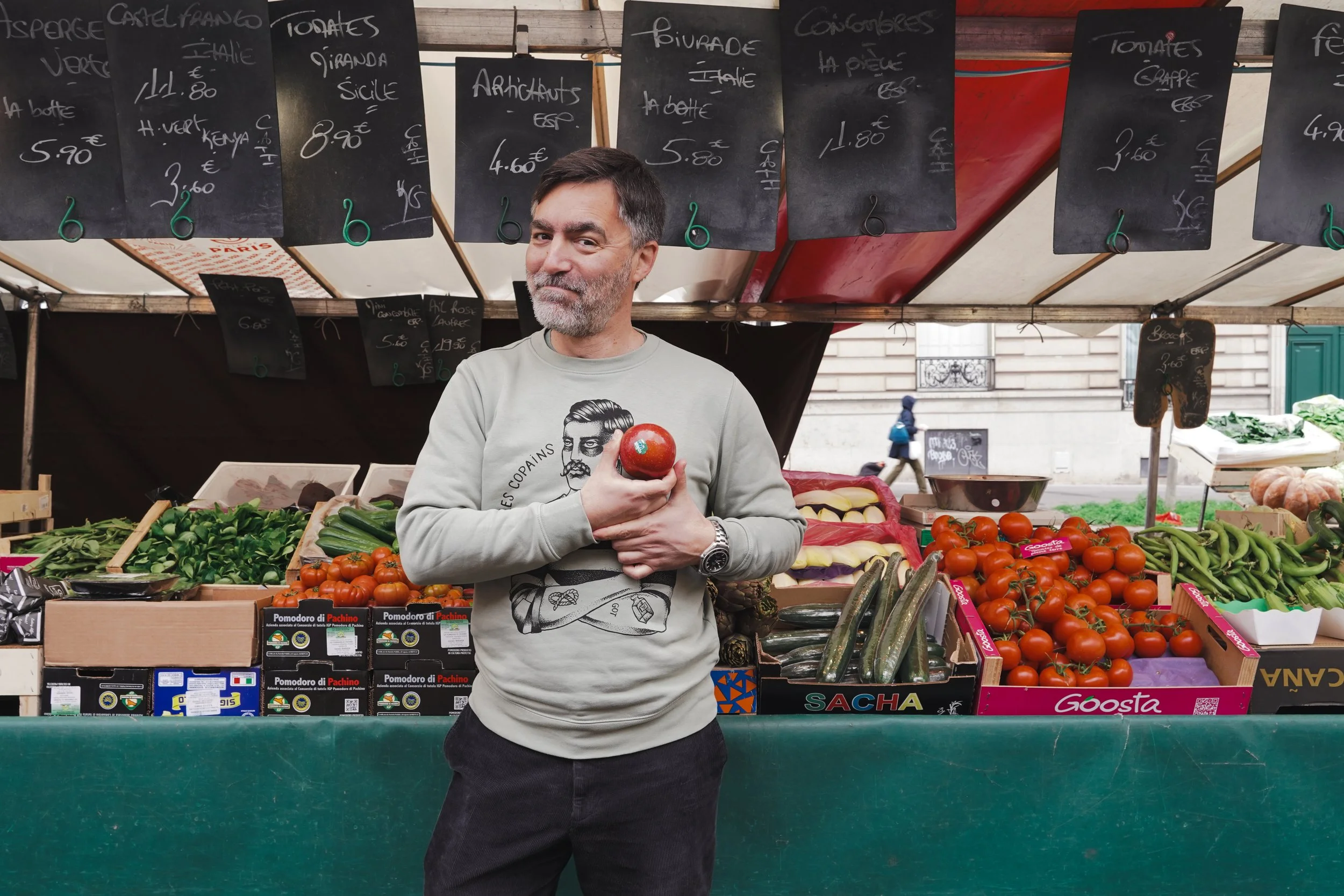
We've got the vegetables, fish, cheeses, and nuts; but where will we get the fruits? I'll answer right away; fresh fruits await you at Mourad's stall. Especially if you love berry varieties, they're always very fresh here. I can say that my daughter's obsession with Fuji red apples started because of this stall. I always have the opportunity to taste whatever fruit I want, just like I'm used to from Turkey. I'm always offered the fruit I want according to the season; this warmth and sincerity are the behavior I value most. Mourad might be the youngest person at all the stalls I shop at, both in terms of age and work experience: It's only been 10 years. I was there at 7 of it Mourad! He can't cook at home, but learning to cook is among his future plans because the products he sells put pressure on him. He says it doesn't seem possible to stay away from the kitchen when such good products pass through his hands, well, go ahead Mourad !

She knows why that apple is there. (photo: Amber)

Finally, let me tell you about the stall that makes me the happiest when I see it at the market. It's the stall of İbrahim and his family, meticulously making “gözleme” in their pristine white outfits. The only downside here is that they can't come on Saturdays because they set up their stall at the Versailles market on Fridays and Sundays. İbrahim also cooks at home because it's part of his family's traditions. They have different varieties of “gözleme” at their stall. My favorite is the one with baby spinach and feta cheese. They make sure all the ingredients they choose are additive-free. Therefore, the taste is equally excellent. We can't enjoy many good Turkish meals outside our home in Paris, but İbrahim and his family's varieties of "gözleme" delight us.

İbrahim’s flour toss. (Of course, he doesn’t do anything like this, it was just my absurd idea.) photo: Amber

Among the regular customers of this market, there are also famous chefs. During my Wednesday routine, I sometimes come across Matthias Marc and Takuya Watanabe. Of course, even though I feel excited to be buying ingredients from the same place as them, the lack of any similarity of the final dishes between what we cook at home and what they cook brings me back to reality. 😃


In Gastronomy, Food, Paris, Cheese, Seafood, Travel Tags parisbywalking, pbw, pbw16th, pbw16eme, parisfood, localeats, localguide, parisfoodguide, parisianlife, parisgram, paris_gram, paris_maville, parismaville, iciparis, cestparis, seemyparis, walkingtours, strollıng, hiddengems, paris, thisisparis

Search Posts

No results found
Post Archive
  • alléosse
  • arles
  • aubergelafeniere
  • baāgaā
  • belen
  • benoîtcouvrand
  • capturestreets
  • cestparis
  • cyrillignac
  • delitaly
  • doitinparis
  • dose
  • expatriatesmagazine
  • ftg
  • gordes
  • grimaud
  • hiddengems
  • iciparis
  • igersparis
  • invitezvouscheznous
  • jaimelesglaces
  • jardindelapiboule
  • lahalledegrimaud
  • lapâtisserie
  • latabledumareyeur
  • latablejm
  • lecriquet
  • lepâtissierduchâteau
  • liberté
  • local
  • localeats
  • localguide
  • loutsider
  • nontouristy
  • ofthebeatenpath
  • paris
  • paris_gram
  • paris_maville
  • parisbywalking
  • parisfood
  • parisfoodguide
  • parisgram
  • parisianlife
  • parismaville
  • pbw
  • pbw10eme
  • pbw10rest
  • pbw10th
  • pbw11eme
  • pbw11rest
 

Powered by Squarespace